

Ink, Datalex and PROS prove the concept of a modular Offer-Order-Delivery. Aligned with IATA’s Industry Transition Roadmap and modern retailing standards
Airline retailing is transitioning from monolithic stacks to modular systems that can be adopted incrementally. Ink Innovation, in collaboration with Datalex and PROS, set out to test whether core functions from different vendors can be integrated as one. The joint project showcased interoperability between the Offer Management, Order Management and Delivery Management domains. It also demonstrated modular capabilities for product catalogues, a stock keeper, and flight plus ancillary shopping with dynamic pricing. There were no Passenger Service System (PSS) or other legacy dependencies. The airline acted as the central integration point.
This project is part of the IATA Airline Retailing Consortium’s modularity challenge. Over nine months, more than 20 IT providers formed eight teams to build live, interoperable demos across Product, Offer, Order, Accounting, and Delivery, using the industry’s Reference Business Architecture (RP 1786a).
What was built and how it works
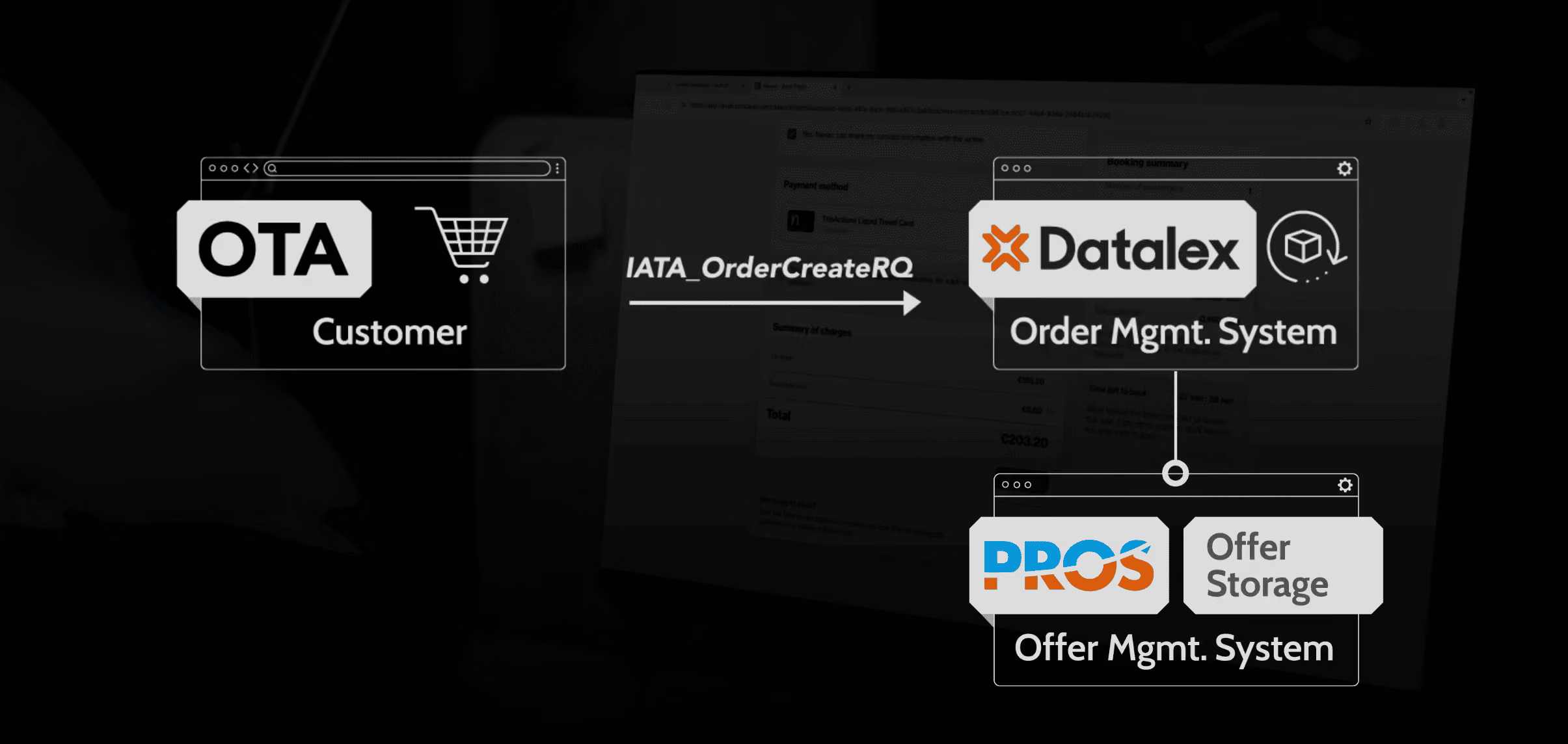
Three domains connect with clear responsibilities. Offer Management (PROS) covers shopping and dynamic pricing. Order Management (Datalex) creates and maintains the order and its state. Delivery Management (Ink) executes airport processes, including check-in, ancillary fulfilment, and delivery status updates. The stack includes a product catalogue and a stock keeper to define what can be sold, shopping and pricing to create offers, and finally order creation and servicing. Each component is replaceable. The airline remains the system integrator, which keeps control and avoids a single-vendor choke point.
Two flows that prove the point
Use case 1. Shop. Price. Order. Pay
Travellers search flights and ancillaries. PROS returns the priced offer. Datalex creates the order and records payment. Offer and Order exchange only what is needed, so state remains aligned and there is a single source of truth.
Use case 2. Delivery-side servicing with feedback to Offer and Order
The order loads into Ink’s delivery environment at the airport. Agents can view the order, add ancillaries, check passengers in and update delivery status. These actions write back to Datalex’s Order Management and, where relevant, inform subsequent offers handled by PROS. The result is continuity from retail to operations. Legacy documents appear only when a journey requires them.

For a quick overview from the people who built it, watch what the team shares about the case with Warren Millington (Datalex), Benjamin Waymark (Ink Innovation), and Christopher Allison (PROS).
What we learned together
- Standards shorten the path
Where standards exist, interoperability was straightforward and teams moved quickly on the covered scope. Profiles reduced ambiguity, testing was simpler, and integration cycles were shorter. - Mind the remaining 20 percent
Standards do not cover every interaction yet. The last mile required closer collaboration and explicit choices. Design decisions had to serve different airline operating models, which meant documenting trade-offs, then moving. - Collaboration is a capability
Three vendors that had not worked together at this depth shipped live flows across time zones while running day work. Clear ownership, tight interfaces, and a shared outcome turned coordination into delivery. - The market opens when systems interoperate
Separating Offer, Order, Delivery did not weaken the end-to-end flow. It enabled it. Airlines can add or swap components without breaking the journey, which increases choice, shortens time to value, and reduces lock-in.
Why this matters for airlines
- Control returns to the airline
Keeping the airline as the integration point avoids a single-vendor choke point. You set the sequence of change and can improve one area without rewriting the rest. - Incremental beats all-or-nothing
You do not need to replace a PSS to capture value. Start with a modular step that fits your context. Dynamic pricing on a target market. Ancillary retail tied to orders. Order-centric delivery at a station that needs relief. Prove the step, measure it, then expand. - Standards reduce friction
The industry Reference Business Architecture (RP 1786a) gives teams a shared map. NDC and ONE Order profiles provide a common language. Integration becomes more predictable, and reconciliation effort in operations goes down. - Vendor choice improves
Clear responsibilities and defined interfaces let you add or swap components without breaking the journey. That weakens lock-in and supports best-fit selection for each capability. - Risk falls and time to benefit shortens
Smaller, well-scoped changes limit blast radius. Benefits arrive sooner, and failed bets can be reversed without destabilising the stack.
Operational impact
Operationally, the Order becomes the single source of truth. Delivery actions update the same record that commercial teams see, so Offer and Order stay aligned, and agents are not juggling disconnected systems.
The knock-on effects are practical. Fewer reconciliation loops, less double entries, and fewer mismatches across channels mean Finance and Accounting face fewer post-facto corrections.
Servicing is faster because agents can see what was sold and what was delivered in one place, so adding ancillaries, checking in, and updating status take fewer steps.
Legacy documents remain an exception. They are produced only for journeys that require them, while the default stays order-centric. Observability improves as updates flow in both directions, which simplifies audit and compliance. Customers experience more consistent information across channels and fewer contradictions at the airport or online.
Next step
Offer-Order-Delivery can span multiple providers, with the airline in control, eliminating legacy system lock-in. A structure that tolerates change and aligns with IATA’s Industry Transition Roadmap and the standards that support it.
Shawn Richards, CEO at Ink Innovation, said:
“Together with Datalex and PROS, we’re enabling dynamic pricing, NDC shopping, and Order orchestration, advancing the industry’s move toward a modern Offer–Order–Settle–Deliver model.”
If you would like to explore how this pattern applies to your context, request a demo call. We will share the full flows, integration boundaries, operational requirements, and then discuss where a focused pilot could start.