



What the IATA World Financial Symposium and World Passenger Symposium revealed about Delivery with Orders, modular OOSD, and the shift to mobile and biometrics. Perspective by Ben Waymark, Ink Innovation. Istanbul, Türkiye. 5–6 November 2025.
Istanbul was the right backdrop for a joint finance and passenger summit. A crossroads city that mirrors an industry shifting from legacy constraints to connected retailing. In her opening, Sandrine Le Borgne, Senior Vice President, Corporate Services & Chief Financial Officer, IATA, set the tone with a clear line. “Retail, passenger experience and financial resilience are inseparable.” That is the right way to judge progress.
The week tracked that logic. The Dynamic Offer Taskforce (DOTF) reported to the Travel Standards Board (TSB). The OneID workshop ran alongside WPS. The common thread was execution. Offers and Orders are moving from theory to operations. Delivery has to keep pace or the promise stalls.
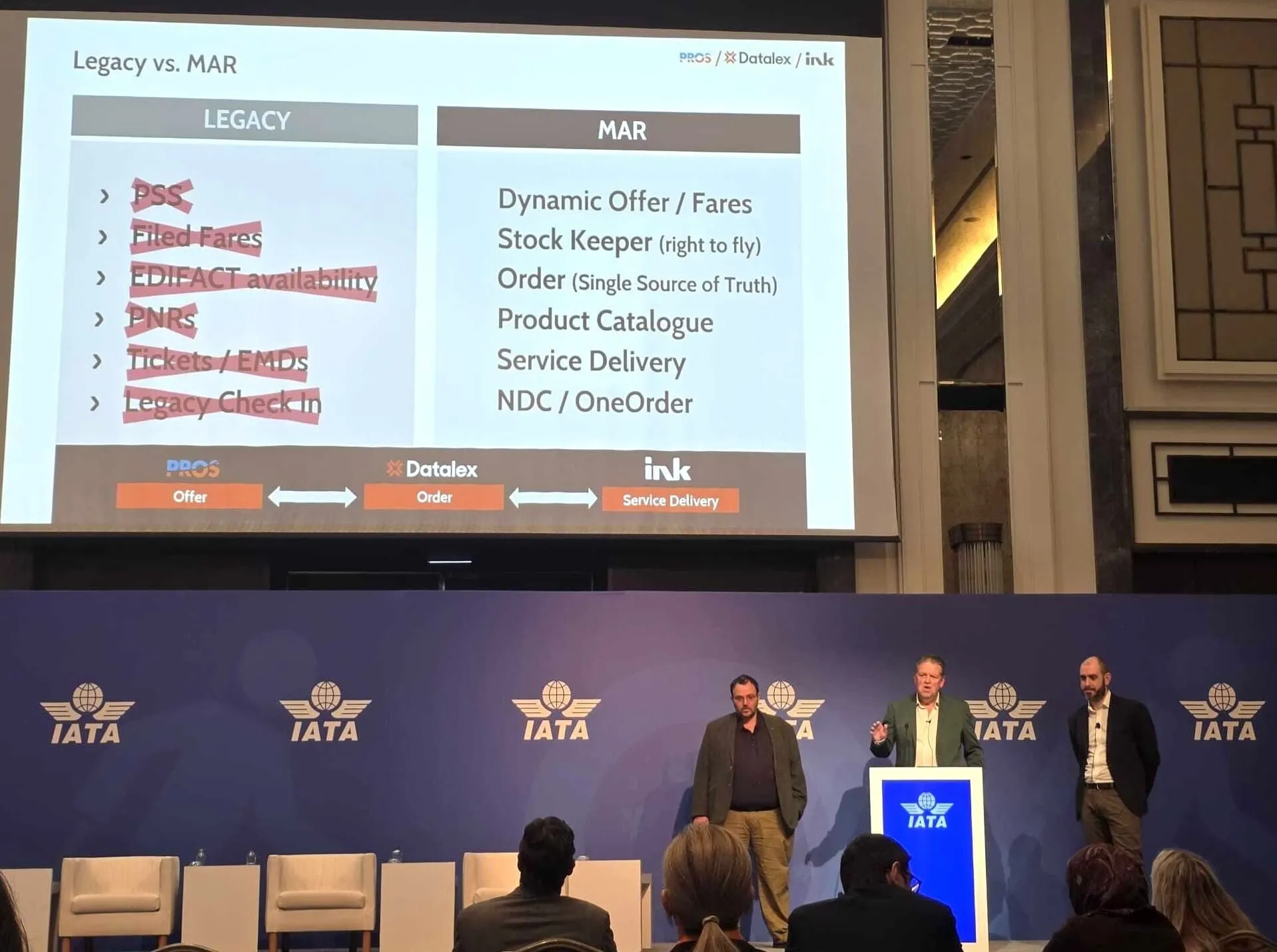
Our highlight was a joint stage session with Datalex and PROS. We showed Delivery with Orders as a working integration. Offer Management. Order Management. Delivery Management. One flow. Not slideware. Delivery Management is broader than a traditional Departure Control System (DCS). DCS is one tool inside a wider execution layer that handles ancillaries, stock, servicing, fulfilment writes, and operational status flowing back to the same order.
The momentum is real. The adoption of Modern Airline Retailing (MAR) is accelerating beyond Europe and North America. Instability still complicates planning, but momentum is real. A useful provocation surfaced. Maybe Offer-Order-Settle-Deliver (OOSD) should be Offer-Order-Deliver-Settle (OODS). You cannot settle before you deliver. That lens forces better sequencing and cleaner data design. Deliver first. Then settle on the same source of truth.
Passengers are pushing in the same direction. IATA’s 2025 Global Passenger Survey (GPS) shows two surges. Mobile reliance is rising. Biometric use is accelerating. Over half of travellers prefer to deal directly with airlines. Mobile web apps are growing fast. Digital wallets gained share while cards declined. 78% want a single smartphone experience that combines wallet, digital ID and loyalty to book, pay and pass checkpoints. 50% have used biometrics somewhere in the journey. Satisfaction is high. Trust is the caveat. Cybersecurity must be designed end to end.
My takeaways:
- Moving to OOSD is a bigger leap than swapping Passenger Service Systems (PSS). Treat it as a business model change.
- Legacy flexibility is tapped out. There is no hidden performance left to unlock.
- New capability lives in modular OOSD. Product, Offer, Order, Delivery and Settle must evolve independently, yet write to a common record.
- Delivery Management is where retail meets reality. It must read and write the order, manage fulfilment and expose status in real time to customers and operations.
- Airlines that commit now bank compounding benefits. Adaptive servicing. Faster change cycles. Cleaner settlement. Lower reconciliation drag.
WFS and WPS made one thing obvious for me. The gap between “what if” and “what is” closes only when Delivery is treated as a first-class domain in airline retailing. Build for modularity. Deliver first. Settle right after. Then scale.

Author

