
In this weekly FAQ series, Ink experts will be looking into how airlines transition to Modern Airline Retailing, and sharing what it means for service delivery, what changes, and the practical steps that make the shift smooth.
In this issue, Ben Waymark explains how moving from PNR (Passenger Name Record) and ticket-based fulfilment to Order-based Delivery changes how airlines run flights, bags, seats, and services.
What does “Delivery with Orders” actually mean?
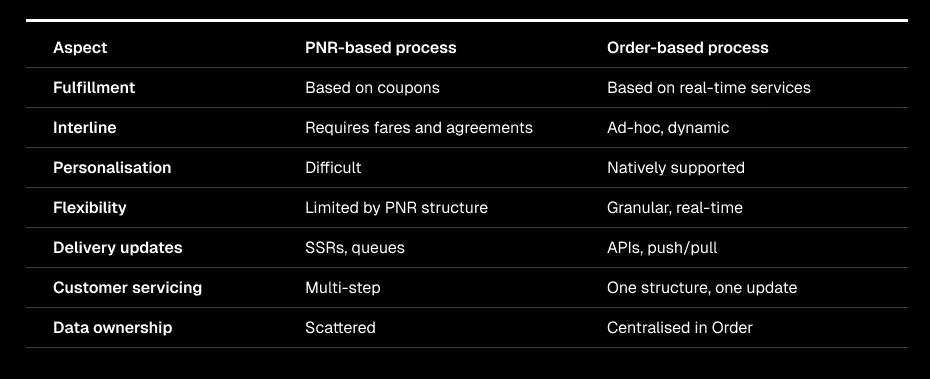
How is the Order-based process better than PNR-based?
Can we start Delivery with Orders if we are still on a legacy PSS?
If we have both PNRs and Orders, do staff need to learn two systems?
Q. What does “Delivery with Orders” actually mean?
In an Order-based model, Service Delivery is driven by the Order, not by ticket records, EMD coupons or PNR-based queues.
All delivery events refer back to Order Items and Services, which carry:
- Passenger entitlements
- Conditions
- Current status
- Associations with flights, segments and delivery locations
Operationally, this means check-in, boarding, bags, seats, meals and lounges are all managed as services on the order. Instead of being scattered across multiple legacy artefacts, they sit in one coherent structure that operations and service teams can work with across channels.
Q. How is the Order-based process better than the PNR-based?
The industry shift to Offers and Orders is not “tech for its own sake”. It is about simplifying processes, lowering costs and enabling retailing models that legacy PNR and ticket-based stacks cannot realistically support.
Here’s the bottom line:
Q. Can we start Delivery with Orders if we are still on a legacy PSS?
Yes, but only if you accept that the PSS is not your Order Management System and you are willing to add an architectural layer.
Legacy PSS platforms such as Amadeus Altea Classic, SabreSonic Classic or Navitaire New Skies in standard mode are:
- Ticket-centric
- PNR-based
- Tightly bound to EMDs and coupons for fulfilment
You do not have to replace the PSS immediately, but you do need to decouple.
Q. If we have both PNRs and Orders, do staff need to learn two systems?
Not necessarily.
When PNR-based and Order-based systems run in parallel, one of them is usually designated as the master record for a transaction. Staff only need to interact with that master system.
Typical patterns:
- PNR as master
The airline continues to use the PNR as a system of record. The team primarily accesses and manages bookings through the PNR interface, even if Orders exist behind the scenes. - Order as master
In a full NDC-ONE Order environment, servicing and retrieval are done via the Order Management System, and the Order is the source of truth.
Integration must ensure that changes in one model are reflected in the other, where required. For example, an NDC Order can carry the legacy Booking Reference, so agents can still retrieve the record easily, even though the structure behind it is different from a classic PNR.
The key is to shield frontline staff from hybrid complexity with clear rules about:
- Which system is the master in each scenario
- How operational interactions are routed to that system
Strategic move
Transitioning from PNR and ticket-centric delivery to Orders is not a single project. It is a sequence of decisions about where your master record lives, how far you decouple from the PSS and when you add NDC on top. Airlines that modernise fulfilment and servicing early will be better positioned when they switch on full Offer-Order-Delivery-Settle retailing.
You can start Delivery with Orders while on a legacy PSS by:
• Adding a decoupled Order Management System layer
• Translating Orders to legacy delivery artifacts (PNR/EMD)
• Gradually modernising around the edges