


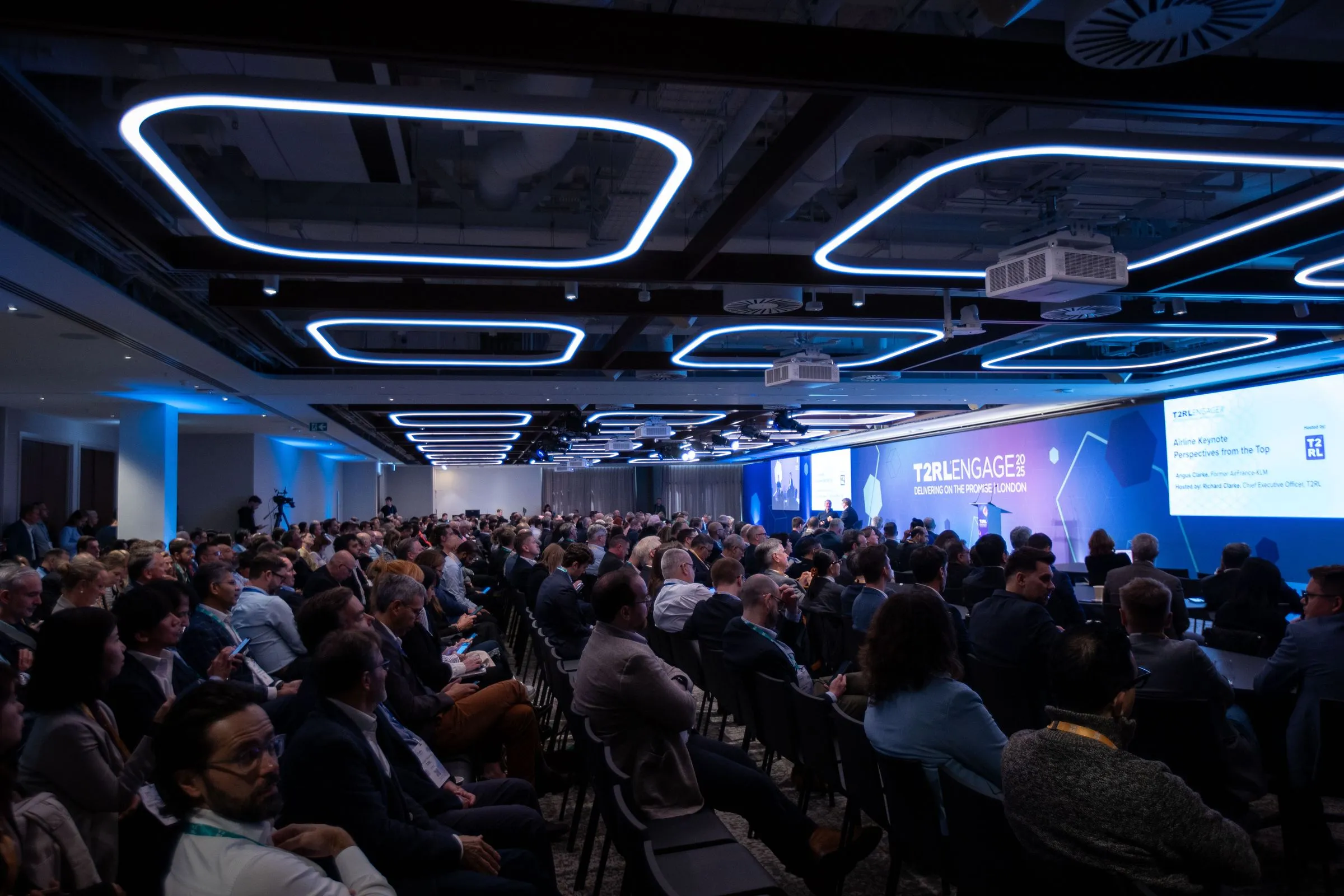

From the T2RLEngage-2025 Delivery track by Ink Innovation to a practical read.
We took the best conversations from T2RLEngage 2025’s Delivery track and turned them into a short, useful read you can share with your team. There’s also a quick update on Aura, our AI-enabled airline delivery platform—now in pre-launch with the Early Access Program.
Why check-in at all?
Check-in has been the industry’s organising ritual for a century. In 2025, it’s the wrong centre of gravity. Our T2RLEngage keynote, presented by Ink CEO Shawn Richards, lays out a simpler model. It suggests moving intent, identity, and document checks upstream by letting AI orchestrate tasks and making baggage and boarding flow with far less passenger work. The aim isn’t “more self-service”, it’s less passenger effort and better promise-keeping.
Read the keynote summary here
Delivering with Orders
Together with Turkish Technology, we demonstrated how a modular, standards-aligned approach enables airlines to deliver services with Orders without a big-bang replacement. Using open APIs and minimal custom code, multiple providers integrate cleanly so core actions—seat assignment, sports equipment, catering, ancillary bundles, check-in and boarding—stay synchronised with the Order. Legacy documents are produced only when required, enabling a pragmatic, incremental path where PNRs and Orders can co-exist while integration effort stays low.
The result is flexibility by design: swap, add, or iterate on components as needed, with Order status updating across systems in real-time.
Read the use-case summary here
Friction-free airports need orchestration
As airlines sell more ancillaries, the promise gap widens. When disruption hits, only a single operational picture—and a clear owner per moment—can keep recovery ahead of the queue.
The roundtable got practical: use order-aware hand-offs between airline, ground handler and airport; apply identity where lawful to remove low-value stops; and agree shared service levels instead of siloed KPIs. PRM journeys and tight connections are the stress tests.
Modularity vs. Standards
Standards matter; modularity delivers speed. This year’s vendor debate was pragmatic: open interfaces, lower integration costs, and AI tools that reduce toil, not create black boxes.
The consensus? Design for a mixed world of PNR and Orders and make migration a feature, not a project.
The hidden power of Delivery. Airline workshop
Ink introduced a pragmatic vision for the next generation of Service Delivery, built on four pillars: AI-enabled automation, digital ID, biometrics, and in-person payments. The focus is on shifting from screens and checklists to orchestration and automation, connecting Delivery earlier with Orders.
The room then explored the realities of getting there: a live demo showed an AI agent preparing a journey, handling bookings, seat moves, and check-in.
Raised concern:
“We’ll be in a situation where we have both PNRs and Orders to manage…Does that mean that all our staff have to be familiar with two systems, which is definitely going to be a challenge?”
The discussion focused on navigating a hybrid phase where PNRs and Orders coexist, as well as an orchestrator that tracks each Order item and feeds status back to the OrMS (Order Management System).
Key takeaways:
- Reputation emerged as the pressure point. The more you sell, the more promises you must keep, so incremental, synchronised steps that keep partners in sync matter most.
- A phased approach is required, maintaining legacy while progressively introducing Order-based processes with new services and partnerships.
Watch on-demand video (airlines only)
What this means for your roadmap
- Start delivery transformation now. Don’t wait for Offer-Order to “finish.” Delivery is your live interface with the customer – and the fastest path to measurable experience gains.
- Treat Aura-style orchestration as your new “DCS.” Same essential outcomes, radically different means. Preserve what’s necessary, expose functions to AI, and simplify the work so people focus on hospitality and problem-solving.
- Build for a mixed-partner future. Keep standards and design for interoperability across PNR and Order worlds, use modular interfaces, and bias for changes that increase speed and resilience.
Join Aura Early Access and help set the new baseline for Service Delivery.


Author

