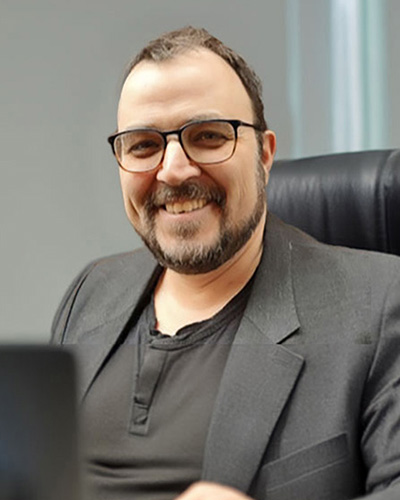

Shawn Richards and Ian Tunnacliffe, SVP Consulting, Editor in Chief at T2RL, discuss Delivery and what shapes it.
In this interview, Ian Tunnacliffe speaks with Shawn Richards about the ‘D’ in OOSD: delivery. Shawn argues that airlines will not get the full benefits of Offers-Orders if delivery stays trapped in a “DCS 2.0” approach. Instead, he frames delivery as the layer that connects Order Management to day-to-day operations, starting as soon as an order exists rather than only in the last hours before departure. He also shares what he sees as the foundations of modern delivery, including AI-driven change in airport work, stronger identity and document handling through digital ID and biometrics, and support for in-person payments in the airport environment.
Watch the full interview or read the transcript.
The transcript
Ian: So, Shawn, the D of OOSD, that is your ballpark. You're possibly the world's greatest expert in new generation delivery systems.
Shawn: Well, it's a grand way to think about it and a grand way to think about us, but I wouldn't go that far as a world expert. I think it's the thing that we specialise in, the thing that we care most about. And in order for it to work well, it's now really about collaboration. It's the collaboration part of being modular.
As I made a point yesterday in my keynote, to achieve real modularity, you have to look at a mix of suppliers, a mix of vendors. And even these words are not the right words. It's a mix of partners because you're trying to achieve something that you can't do on your own, and you need to do that collaboration piece.
So yes, we do specialise in the deep part of it, but we're working to become the experts.
Ian: And of course, it's not the main subject for today, but we would be remiss not to mention it. You're going live with a pretty important customer sometime fairly soon down in Saudi Arabia.
Shawn: Yes. We’ve been working in secret for quite some time, but it's been revealed – the partnership that we've been working on for more than a year. It's an extremely exciting product and adventure that we're doing there. The collaboration is first-class. So we're working very closely with Flyr and a bunch of other partners, and they've been bringing their vision together, and they are really embracing modularity for real. So it's a little bit like a shipyard, a busy shipyard. It looks like organised chaos, but there's just a lot going on, and a lot of parties have to talk to each other and work together to try to achieve what is, I would say, a first-of-its-kind project in aviation: bringing OOSD to life at scale.
Ian: At scale. Yes, cos, as we've said in this conference a couple of times, there have been one or two small-scale implementations in the past, but this will really be a proper grown-up, at-scale implementation.
Shawn: Yes. We were very proud to have worked with the airline Flyr in 2022, based in Norway, and that's where we cut our teeth in delivery, actually. They put together an OOSD stack that is really driven on bespoke APIs rather than NDC. Their ONE Order was assembled quickly, and it ran at a small scale. They didn't have a scale; the total number of orders was about 1.4 million, which we handled in our system, but these orders were handled in production. And that's a different problem from scale.
So you have scale as one problem, and production is another problem. Going into production, having to work and collaborate with the OMS, the OrMS, we were working on orders, extracting data from that, and collaborating, and for a lot of the time at the beginning, both of our tails were on fire, right? Things were going wrong; you had to fix them really quickly. It was very exciting, and that's the nature of innovation: it's not a perfect, polished thing. That's what you do when you're scaling something that you have already innovated. And we like innovating. So that's messy. That's collaborative. There's some shouting, twoing, and throwing involved, but that's how you get to something new.
Ian: A lot of the implementations or the commitments that we're hearing about, to offers and orders, seem to be planning just to go on using the existing DCS for the time being. And you think that's probably a mistake and that to realise the full value of moving to offers and orders, you really need to move your delivery capability in step with your move to offers and orders.
Shawn: Yes. So from what we've seen, offers get a lot of attention. Orders are getting increasing attention. But a lot of people who haven't really stopped to think about delivery think, well, we'll take DCS 2.0. That's one viewpoint. We'll evolve a DCS, and that'll handle delivery. The other viewpoint is that delivery kind of disappears. DCS disappears, and it just becomes a function of the OMS. I think the latter is more true than the former.
The DCS, or the departure phase of OOSD, the departure phase of delivery, does incorporate all of the functions that currently come under a DCS. But the DCS, this container of those functions, will drift away because the delivery system needs to be the pulse of the OrMS.
The OrMS takes orders online and is connected to the person, but not to the operation. The delivery system is what connects the OrMS to the operation, the operational world, let's call it the real world, as far as operations are concerned. So that part requires far more sophistication than the old model, which just needed to get people and bags on a plane and do load control.
Ian: I know, when you and I had a conversation last year, we were talking about this, and basically, the legacy model of DCS is that the DCS does nothing until 24 hours before departure, and then it's all happening at the airport. Your vision is much more than the delivery system being involved from the moment the order is created, interacting with the order and possibly working with third-party partners, and a whole load of other things. Still, it should be very much integrated into the order flow.
Shawn: Yes, we've gone ahead and doubled down on that, actually. So, as you know, at the time we had quite strong opinions as to whether this was the way to go, whether it made sense or not. And we do think that delivery does begin after the order is created. But what we found in practice is because we do not want to be the single source of truth. We're actually connecting any of these transactions back to the OrMS. And if there are catalogues that do not happen to be in the OrMS, if we manage to sell something because an airline believes in our model, we still have to say it back to the OrMS, and they will route it through to the settlement system.
We're not trying to break the model, but we do see that airport windows disappear.
Ian: So that's talking about bringing forward the kind of operational, getting the delivery system involved in the process as soon as the order's created. But what about the sort of systems architectural view? A lot of airlines are moving to offers and orders now. And as I say, just putting delivery, as my Irish friends say, putting delivery on the long finger. Just say it'll take care of itself. And you would say, no, actually, guys, you need to be thinking about that at the same time as you're thinking about your move to offers and orders.
Shawn: Absolutely. So the temptation is to really specialise in what's happening with the order right now. kind of figure that out first and then deal with delivery later. We consider that a mistake.
Strategically speaking, it makes far more sense to think of delivery almost first because delivery is what interfaces the order with your customer.
How could you think of guest experience last? You need to think about what you're trying to achieve as part of the transformation to offer and order.
It's not just about coming up with a new business model; it's about transforming your business.
If you're transforming your business, the dialogue an airline has with its passengers needs to come first, because that then defines what you implement in the order management system, which flows through to the delivery system.
So it's a different approach where you don't treat the delivery part of it like “okay, a DCS to get people on planes”. No, it's guest experience. So there are multiple touch points. How does that all come together? How does the passenger experience that? And that is something you can't think of last.
Ian: Okay. And probably there's an implication as well, which is as well as technology, airlines have to be thinking about their processes, their staffing, their training, their just generally how they're organising their business, as well as or even before they think about actually we're going to switch this piece of technology out for that piece of technology. They've really been thinking about their business strategy first, which is always the message for projects. Always decide what you're trying to achieve before you start writing code.
Shawn: Absolutely. We've launched a new product, and it's really shaping the future of what delivery is going to be. It's built on four pillars. The pillars are: AI, digital ID, biometrics, and payments. And we suggest that airlines that are looking at delivery also look at these core pillars because you need to identify people more easily, you need to control documents in a more modern way, and you really need to look at the effect that AI has on your workforce. Their jobs are going to be different. The number of people is going to be different. What they do is going to be different. So you take all of that into engineering, what happens?
And then we strongly believe that in-person payments are a core pillar. When you do all this retailing, how are you going to pay for it?
So it needs to be easy to pay for. I saw this year that T2RL placed a strong emphasis on the payment stream. That's because it's important. And we are looking very much at the in-person payment side of it, not at online channels or mobile, to elevate the experience to what people expect. You get a smoother experience at the restaurants, and in the end, you could just easily pay, or it's in duty-free. But it's not like that when buying airline inventory at check-in. We just want to simplify that.
Ian: And that's an interesting sidelike on some of this stuff because maybe some of the people watching this don't actually understand this, but you're not just a software company, are you? You're involved with some of the hardware that goes into the airport. And so you've probably got a deeper understanding of what you can achieve with the synergy of modern hardware and modern systems to enhance that customer experience.
Shawn: Yes. As part of that, we've looked at a new generation of software and a new generation of hardware that works with it. So, they come together to give a much better experience.
We're actually using the opportunity to get rid of all the legacy that we can think about.
So that means it's much easier to connect to different systems, much easier for people to use, and it's just geared towards the experience rather than an experience shaped by the constraints of the hardware and software middleware around today.
We're looking at what you're going to be doing in 2030, 2035. And what people are doing today outside aviation is what we're trying to bring into it, with a cleaner, more modern class of hardware and a slicker software experience as well.
Ian: You know, you're in danger of making the airport experience pleasant again.
Shawn: Well, hopefully. We've got a great team working with us. They share this vision of just simplification and just relentless modernisation.
We're not looking to just reform things. You didn't get a light bulb by continually improving a candle, right? You have to do something completely different if you want a completely different experience.
Ian: And I think that's a really good note on which to finish. You're not trying to improve the candle. You're trying to invent the light bulb.
Thanks, Shawn.