



A decade of change in Sweden's regional air travel market. In conversation with Ola Strangeways, an aviation professional with over 30 years of experience across the Nordic region.
In April 2015, the control tower at Örnsköldsvik Airport went dark. The controllers left, and the flights kept running, managed from a facility 150 kilometres away. It was the world's first certified remote tower system. At small airports, air traffic control was consuming up to 40% of operating costs, and the traditional model was not viable. The technology has since been adopted in Norway, the United Kingdom, Belgium and beyond.
That same practical thinking has further shaped Sweden's regional air travel market on the ground.
The most used is not always the best fit
Sweden has 33 airports with scheduled commercial flights, serving a network of over 200 aerodromes. Three serve as primary international hubs: Stockholm Arlanda, Gothenburg Landvetter and Malmö, managed by Swedavia. The difference between these groups isn’t just about how many passengers they serve. They operate in completely different ways.
Geography plays a big role. For example, Norway has few roads and railways; before air travel, boats were the primary way to get around. Northern Sweden is vast with limited surface connections. In these areas, regional airports, small airlines, and ground handlers do more than just support commercial flights. They help patients reach hospitals, let contractors get to wind farms before winter, and keep remote towns linked to the rest of the country.
Dala Airport, for instance, besides commercial flights, handles flight training and ambulance services. Even outside regular hours, a 24-hour emergency call-out service makes sure urgent air transport is available.
At the international airports, the major carriers require ground handlers to run departure control systems built for high-volume hub operations, locking them into long-term contracts with dominant market players. Significant hardware investment, dedicated fixed desks, training cycles measured in weeks. For a regional operator running three or four flights a day on aircraft of 72 seats at most, that model was never a realistic fit.
"There's Ink, and there's nothing and nothing and nothing, and then there's Altéa," says Ola Strangeways, who leads Svenskt Ambulansflyg and has spent his career across the Nordic aviation market. For the regional market, he argues, it comes down to two things: a mobile solution that demands very little infrastructure and an accessible price tag. With a regional aircraft, one agent can handle the entire check-in.
A ground handler can run a common-use counter for multiple airlines from the same device. This is the reason why Allied Aero moved to Ink. They have dispatched their first flight using Ink’s mobile DCS on February 26, 2026. Grafair, for example, adopted Ink because they needed their own in-house system: one that could handle multiple airlines at the same counter without depending on whichever system a visiting airline happened to use.
The passenger who cannot choose otherwise
Fifteen years ago, regional passengers in Sweden were much like they are now. Most travel for reasons they can’t put off, like medical appointments, business meetings, or work trips up north. These travellers aren’t choosing between options. For many, the regional flight is the only way to make the trip in a reasonable time.
What has changed is what passengers expect from their journey. Swedes, as Ola says, are "very high-tech." Many arrive with their boarding pass on their phone, want real-time updates, and prefer to move through the airport quickly. Most are regulars. "Some of the passengers are returning basically every week," Strangeways notes. "They know which seat they want, how they want to be treated, and they always have the same bag." At regional airports, this familiarity is part of the service, and it’s something an automated kiosk can’t replace.
Meeting the passenger, not waiting for them
At Sweden’s regional airports, most passengers travel light. "Back in 2018, at Air Leap's morning departures at Stockholm Bromma, we stood outside on the curbside. Everyone arrives by taxi. We could meet and greet the passengers. Those with hand luggage could be checked in on the spot and head straight through, the others got a bag tag and went to the bag drop," shares Ola Strangeways. Two agents managed the whole departure without needing a desk. When boarding started, the agent at the door moved to the gate.
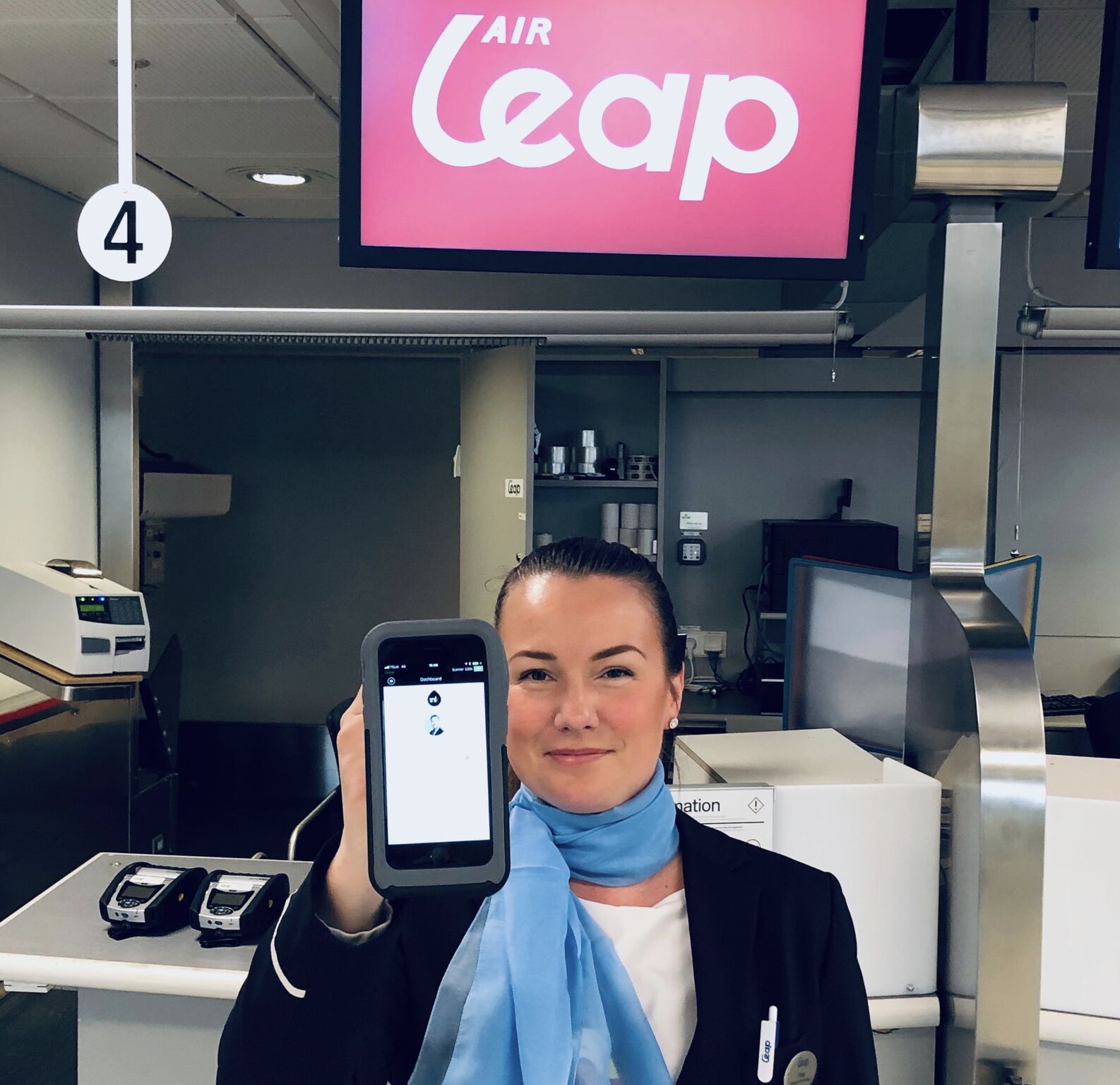
That model only works when the system travels with the agent. Ground handlers, including Allied Aero, Interhandling, run exactly this way, using Ink DCS from a single mobile device. No desk, no fixed installation.
The return boarding pass is a detail worth noting. A large share of regional traffic is business passengers on day trips. Issuing the return pass at check-in removes a step at the other end of the journey. "People don't realise it until they get the system," Strangeways says. "Then it's: oh my god, we get the return boarding pass."
The legacy problem, and the alternative
"It's like Facebook," Ola Strangeways says. "You don't get a manual with Facebook. You just start."
“I remember a new agent on the island of Åland. She went for a week to understand a legacy DCS and still didn't get it. And Ink she learned in a few hours."
It is a gap Ola has been watching closely over the course of his own career. When he started as a check-in agent in 1989, he had never seen a computer screen. Learning a command-line system took weeks and was, by his own account, terrifying. Today, he says, you can take a new customer service agent, give them a full day with Ink, and they will be proficient. One agent in southern Sweden summed it up differently: "This is so boring, it's like Tinder."
In a small regional operation with no dedicated training function, that difference determines whether the operation can run.
What the past decade leaves behind
Strangeways is frank about the airline industry: “It is conservative as hell. If something works, we are really reluctant to change it." This resistance to change has slowed adoption in the regional market.
A carrier or ground handler running mobile DCS today can manage a full departure with two agents, one device and no permanent desk. Kiosks, once seen as the next step for smaller airports, have largely become a redundant question. When passengers are already checking in on their phones and carrying a boarding pass in their wallet app, the case for fixed self-service hardware at an airport handling four flights a day is difficult to make. For this market, mobile departure control is simply enough.
Sweden led the way with remote towers for practical reasons, not because of grand visions. Choosing mobile DCS on the ground follows the same logic: use what works best for your actual needs.
Thanks to Ola Strangeways of Svenskt Ambulansflyg and Nordic Aviation Support for sharing his insights on the regional market. This article also uses information from LFV, Saab Digital Air Traffic Solutions, the SESAR Joint Undertaking, and Swedavia.

Author

