IATA Demo Day 2026: what two airline-voted demos proved about multivendor Offers & Orders
Modern Airline Retailing gets a live test: two multivendor demos carried one Order from the first search to a disrupted interline trip, with Offer, Order and Delivery coming from different providers. Both will be replayed at World Passenger Symposium in Macao.
For years, the case for Modern Airline Retailing (MAR) has been made in architecture diagrams. Airlines have been told that they can pick the best provider for each part of the journey, and that Offers and Orders will hold the pieces together. What they have seen far less of is that promise running live, across companies that do not normally share a stack, and often compete.
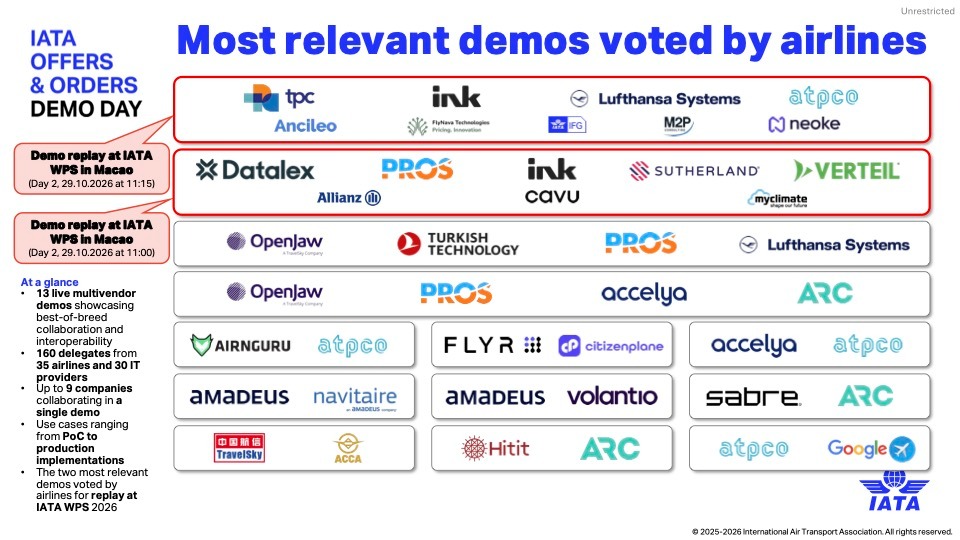
That was the point of the second IATA Offers & Orders Demo Day, held in Geneva in September, where 13 live multivendor demos were put in front of airlines. Airline participants scored them and selected the two they found most relevant.
Ink Innovation was the only Delivery provider involved in both selected demos: one covering the full passenger lifecycle, the other interline and disruption. Together, they offer a practical picture of what a modular, Order-based airline can look like and where the work remains.
One Order, from shopping to flight flown
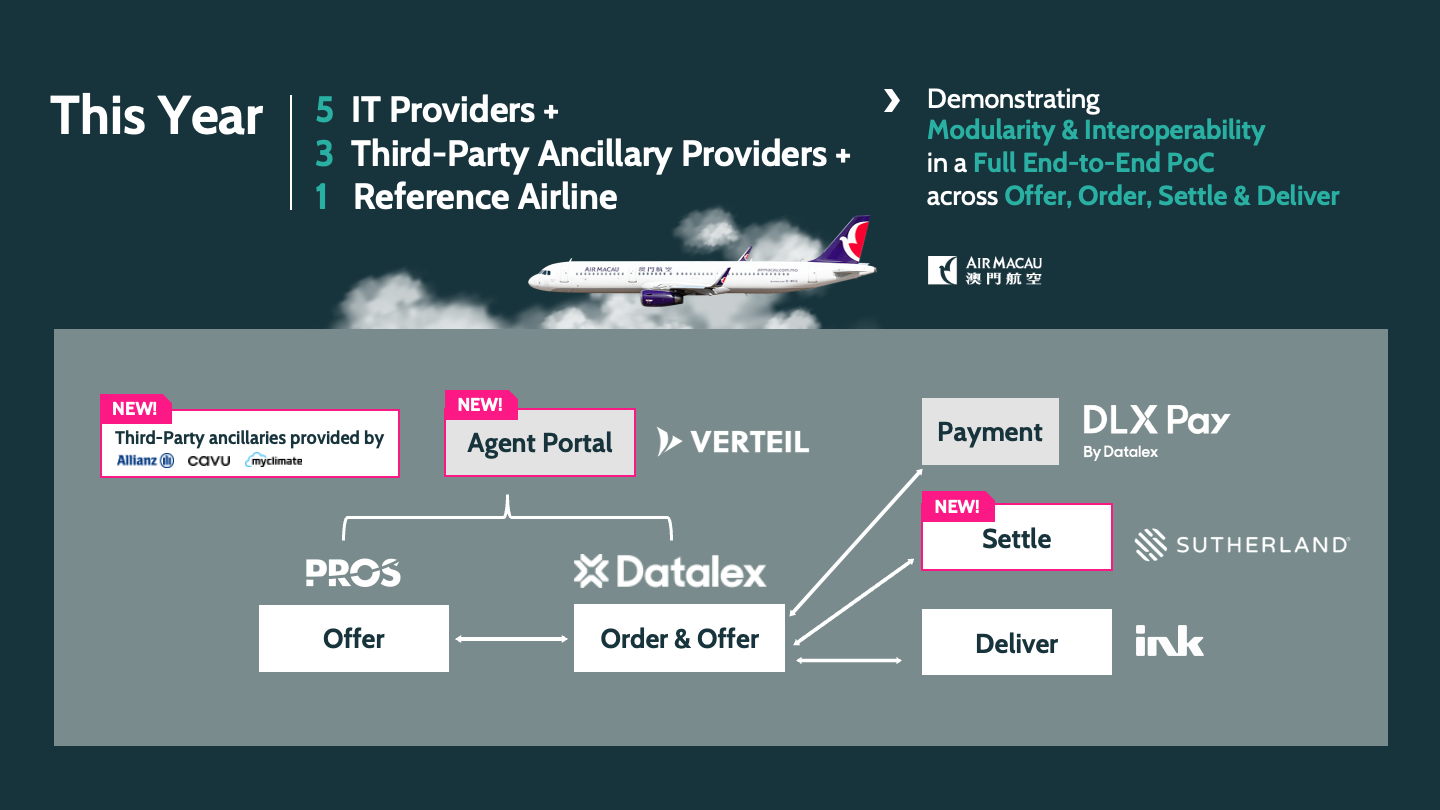
The first project brought together Datalex, PROS, Sutherland, Verteil and Ink Innovation, with third-party providers CAVU, myclimate, and a travel insurance provider. Air Macau served as the reference airline, supplying the flights, products and services used in the demonstration. It was one of the two demos airlines rated most relevant.
The scenario followed one customer through the entire lifecycle. A Verteil agency portal shopped PROS dynamic pricing and flight offers over NDC. Once an offer was selected, Datalex’s order management system created the Order and DLX Pay, a standalone payment orchestration product, processed payment, while PROS confirmed stock and updated inventory. Ink’s delivery system and Sutherland’s order accounting were notified automatically that there were services to deliver and to account for.
The more telling test came next. The Order, originally created through an indirect channel, was retrieved and serviced on the airline’s own website, where the customer added travel insurance by a third-party provider and climate protection projects by myclimate, both offered directly by the providers in real time. At check-in, handled by Ink, a fast-track security service from CAVU was added on the spot. Check-in, boarding and flight flown each sent a status update back to the Order, and Sutherland recognised revenue for each product only once the service had been delivered.
The significance for airlines is in what stayed constant. The same Order connected sales, servicing, airport delivery and accounting, while the different components operated independently around it. The demo showed how airlines can combine capabilities from different providers rather than relying on a single technology stack. It also showed something important at the point of Delivery. Products do not have to be sold only during the original booking. Services can be added at relevant moments later in the journey, including at check-in, while remaining connected to the same Order. This creates additional opportunities to generate ancillary revenue at moments when the service is most relevant to the passenger.
“Working alongside technology vendors and third-party ancillary providers, we proved that the Stellex platform integrates within a modular ecosystem, with every module operating independently yet performing as if it were one unified system,” highlighted the Datalex team. “This POC confirms what Datalex has long believed: a modular, multi-vendor ecosystem works in a live environment.”
“Every interoperable step we demonstrated cuts effort and de-risks the transition to Offers & Orders,” added PROS. Sutherland described a live order moving from offer to booking, fulfilment and settlement “with no manual handoffs”.
Read more on the case scenario here.
Interline and disruption, on a single Order
The second project tackled a harder problem: modernising interline. Today, airlines rely on established ticketing, messaging and settlement processes to keep multiple carriers aligned. They work, but they can also introduce constraints when airlines want to retail, service and recover a journey dynamically across partners.
TPConnects, Lufthansa Systems, ATPCO and Ink formed the core of the build, with Ancileo, FlyNava, IATA IFG, M2P and Neoke each adding a specialist capability, from insurance and dynamic pricing to payments, digital identity and disruption handling, to the same Order.
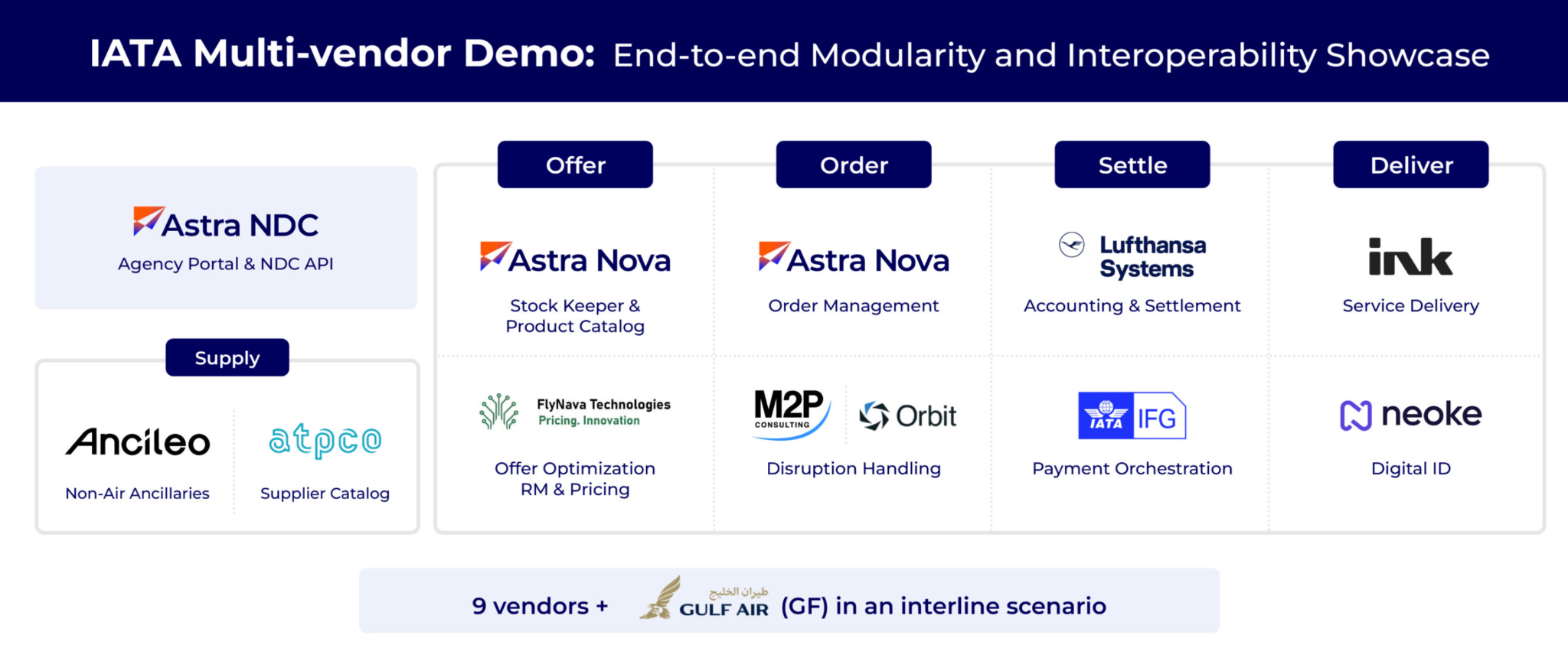
The group tested it with a realistic itinerary: an outbound flight on one airline, a return on another and a third-party insurance product. TPConnects issued the whole trip as one Order, using flight and fare data from ATPCO. Extra baggage and lounge access were then added after confirmation, including at check-in, and attached to the same Order without anything being reissued. Ink handled check-in and baggage delivery from that Order, and Lufthansa Systems settled it, splitting revenue automatically between the two airlines and the insurer while keeping the original bundle distinct from later purchases.
Then the itinerary was disrupted. The passenger was offered an alternative, and the existing Order was updated in place rather than cancelled and rebuilt.
For airlines, this points to three practical gains: ancillary revenue that no longer leaks at the seams between carriers, settlement that follows the Order instead of being reconstructed after the flight, and reaccommodation that becomes an update to a live record instead of a manual exercise between airlines.
“A passenger’s journey today goes well beyond the booking itself – product offers, ancillary sales, airport services, insurance, disruption, and recovery, often spanning across multiple carriers and systems,” said Praveen Kumar, CTO at TPConnects. “This POC proved that in the new Offer and Order world, a single, living order can manage that entire Supplier-Retailer complexity end to end, without fragmentation and manual reconciliation. This is no longer a future state; it’s today’s reality.”
“With TPConnects and the partners, we proved, for the first time in the industry, that interline can work between two OOMS-connected airlines without translating from legacy systems. This means that at the point of delivery, all retailing options are available without being constrained by IATCI and other legacy messaging,” said Oana Savu, Chief Growth Officer of Ink Innovation.
At Delivery, the implication is significant. The airline can work directly from the Order rather than translating the journey back into legacy operational records, opening the door to richer retailing and servicing at the airport.
Read more on the case here.
What still has to happen
Both projects ran in controlled demo environments. There is still work ahead around scale, legacy coexistence, interline agreements, standards, and operational adoption.
The question is becoming less about whether different Offer, Order, Finance, and Delivery providers can work together and more about how airlines take that model into production.
That is important because few airlines will move to Offers and Orders in one step. Most will transition over time, combining new capabilities with existing systems. A modular approach lets them make that transition progressively rather than replacing the entire stack at once.
Ultimately, the value of an Order-based model has to reach operations and the passenger. That is where an Order moves from an architecture concept to something airlines can actually use to retail, deliver, and recover the journey.
See it live at WPS
Both demos will be replayed at the IATA World Passenger Symposium in Macao, with the partners involved. Airlines interested in what a shared Order means for retailing, interline, disruption and airport delivery can see the flows first-hand, or contact Ink Innovation to discuss how they might apply in practice.
Join us at the IATA World Passenger Symposium (WPS).
Explore Demo Day 2026, visit the IATA page