
Check-in, boarding and baggage do not go away when airlines move to Orders. Which departure control capabilities stay, what changes, and how a DCS and a delivery system fit together.
Airlines are moving from PNRs (passenger name records) to Orders, the model behind IATA ONE Order and NDC. That raises a fair question for anyone running departure control: what does a departure control system (DCS) still have to do, and what changes?
The short answer is that the passenger-facing jobs stay the same, whatever the system underneath. What changes is the record they work from and how the airline proves what was delivered.
Which DCS capabilities stay, whatever system you build?
- Check-in: confirming who is travelling and issuing boarding passes.
- Seating: assigning and changing seats.
- Baggage: accepting bags and issuing bag tags.
- Government processes: collecting and checking the passenger data that authorities require.
- Boarding: confirming each passenger on the aircraft and closing the flight.
- Load control: feeding the figures used to plan an aircraft's load and calculate its mass and balance.
- Continuity: keeping check-in, boarding and bag processing running when something fails.
Passengers still arrive at an airport, bags still need tags and a flight still has to close on time. An Order does not remove any of that.
What changes when the airline moves to Orders?
The record. The Order ID becomes the primary reference for everything, in place of the six-character booking reference. In practice both coexist for now, because baggage messages, APIS (Advance Passenger Information System) and ground handling systems still expect the old code.
The job of delivery. Every service on an Order has a delivery status code, such as Ready to Proceed, Ready to Check In, In Progress and Delivered. Updating those codes as check-in, boarding and the flight happen is the core job of a delivery management system. The rest of what a DCS does is built around it.
The selling does not stop. Because the system is API-based, an upgrade or a seat change can happen after check-in, and each one is tracked through the same status mechanism.
So is it a DCS or a delivery system?
Both, in the sense that matters. A delivery system still needs every DCS capability above. A DCS in an Order world also needs to speak Orders. Our platform, Aura, is built on operational DCS heritage and serves both traditional PNR-based environments and Order-based delivery, so an airline does not have to choose one day and replace everything the next.
Can agents use mobile devices for check-in and boarding?
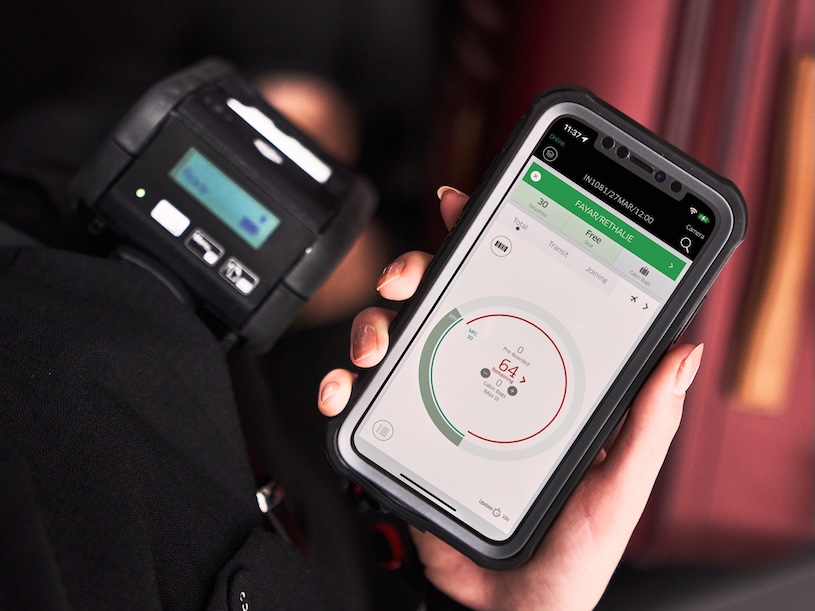
Yes, if the platform supports it. Check-in, boarding, baggage and government processes can run across agent, mobile and self-service channels, and a mobile agent tool lets agents process passengers away from a fixed desk, including off-airport and during disruption. Which mobile devices an agent can use depends on the platform and the airline's set-up, so it is worth asking early.
Does it have to work with our current PSS?
It should. For example, Aura is PSS-agnostic and works with Sabre, Amadeus Altea, KIU, GO7, Avantik or any PSS, and with any order management system (OMS). It supports IATA ONE Order and NDC natively.
Do we need to replace our DCS to move to Orders?
Not necessarily. An airline can start with an advanced DCS, add selected capabilities around its current stack, or move progressively towards delivery with Orders.
